
Our Director of Life Sciences and Competition, Dafne Guerra, spoke with LexLatin about the differences between Chile and Brazil regarding competition law, in light of recent actions related to digital platforms.
Searching for a news story on Google takes just a few seconds. A headline, a few lines of context, and—increasingly—an AI-generated summary are enough to answer a question without leaving the search engine. What is a simple, everyday action for millions of users has become a dispute for the media and competition authorities that could change the rules of the digital ecosystem in Latin America. Brazil is currently the main stage for this discussion.
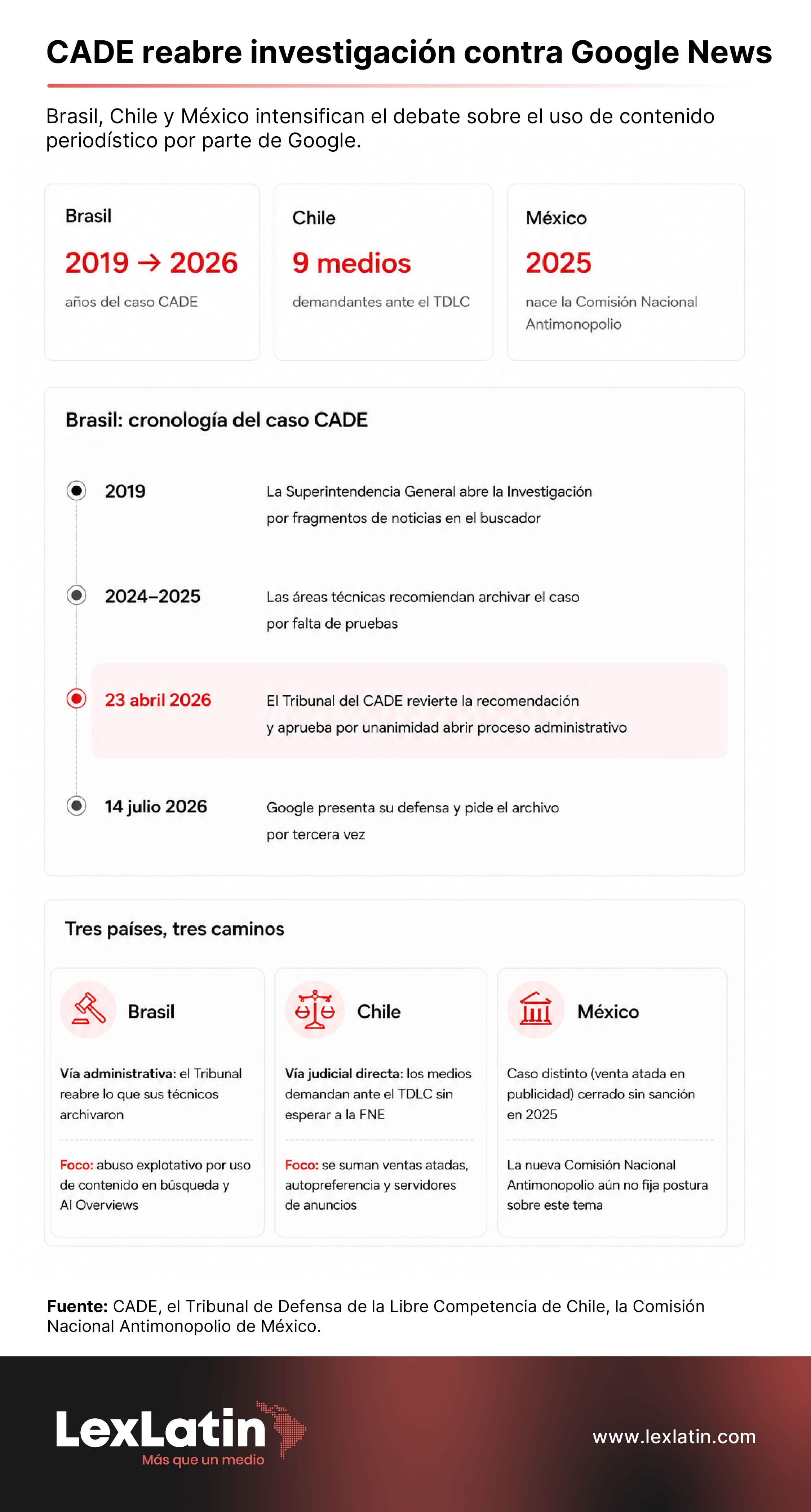
A case that authorities dismissed twice due to lack of evidence ended up becoming one of the most closely watched digital competition enforcement proceedings in the region. Since 2019, the Administrative Council for Economic Defense (CADE) has been investigating whether Google exploits Brazilian journalistic content without compensation—first through news snippets in search results and, more recently, through AI-generated summaries known as AI Overviews. The General Superintendency and the Department of Economic Studies recommended closing the case on two separate occasions. The Tribunal overruled them both times and, on April 23, 2026, unanimously approved the opening of a formal administrative proceeding against the company. Google also responded on July 14 with a defense brief of over 100 pages requesting that the case be definitively dismissed.
The debate over the tech giant’s use of journalistic content also reached Chile and Mexico, albeit under different institutional frameworks. In Chile, six television channels, two newspapers, and a news network filed a complaint against Google with the Court for the Defense of Free Competition over conduct similar to that being examined by CADE. In Mexico, however, the then-Federal Economic Competition Commission (Cofece) closed a separate investigation against the company in 2025 without imposing any sanctions, shortly before being replaced by the National Antitrust Commission (CNA).
Three jurisdictions, three authorities, and one question. When does a closed case truly cease to be the end of an investigation?
Chile Proceeds with Litigation Without Waiting for a Case to Be Closed
In Chile, there is no equivalent to Brazil’s “avocação,” and according to Dafne Guerra, director of Life Sciences and Competition at az, this is because the Chilean system separates investigative and judicial functions into two independent bodies. On the one hand, the National Economic Prosecutor’s Office (FNE) is a decentralized body with legal personality and its own assets, independent of any other agency or service, primarily responsible for investigating and prosecuting violations of free competition. On the other hand, the Court for the Defense of Free Competition (TDLC) is a special and independent judicial body whose primary function is to adjudicate, rule on, and impose sanctions for violations of free competition.
If the Prosecutor’s Office decides not to prosecute a case following an administrative investigation, that decision does not constitute res judicata. In such a scenario, the FNE itself may reopen the case if new evidence emerges; any interested party may file a new complaint with different facts or evidence; and those affected may file a lawsuit directly with the TDLC based on the same facts that the Prosecutor’s Office chose not to pursue. According to the expert, this structural difference explains why the Chilean media have not waited for a ruling from the Prosecutor’s Office and have instead chosen to litigate directly before the Tribunal.
“This is precisely what happened in Chile, where the media filed successive lawsuits over conduct that would continue to unfold and evolve. CNN Chile’s complaint makes this explicit by arguing that the alleged conduct does not constitute ‘isolated illegal acts or one-off incidents, but rather the systematic expression of anticompetitive strategies,’ and that, because these are single, ongoing violations, the statute of limitations ‘does not begin to run until the conduct has effectively ceased.’ Under this interpretation, conduct dating back to 2014, for example, would still be actionable in 2026. This is the same argument that would have been made in Brazil when characterizing AI Overviews as a new and more sophisticated phase of the same conduct that has been under investigation since 2019,” he notes.
Consolidated Lawsuits Against Google in the TDLC:
- March 2024: Copesa, publisher of *La Tercera*, files the first lawsuit of this kind in the region
- December 2024: Cooperativa and *El Mostrador* join the proceedings with separate lawsuits
- April–May 2026: Anatel’s channels—Canal 13, TVN, Mega, Chilevisión, and TV+—file consolidated complaints under Case No. C-549-2026
- June 2026: CNN Chile sues Google, and the TDLC automatically consolidates the case into the same docket
Regarding the conduct being prosecuted, Guerra notes that CNN Chile’s complaint is based on the same logic that ultimately broke the deadlock in the Brazilian case: characterizing scraping and generative summaries as a single ongoing act, rather than isolated incidents subject to the statute of limitations.
CNN Chile’s complaint argues that the alleged conduct does not constitute isolated offenses or one-time events, but rather the systematic expression of anticompetitive strategies and that, since it is a continuing violation, the statute of limitations would only begin to run once the conduct effectively ceases. Under this interpretation, practices that began, for example, in 2014 could still be subject to prosecution in 2026.
However, Guerra notes that there are significant differences between the two systems. While in Brazil the administrative proceeding only moved forward after the CADE Tribunal overturned the General Superintendency’s recommendation to dismiss the case through the process of “avocação,” in Chile there is no equivalent filter. Once a complaint is filed by a private citizen and the legal requirements are met, the TDLC must accept it for processing, even if the FNE had previously closed an investigation.
Regarding the merits of the case, the attorney notes that Chile and Brazil share a common thread: Google’s alleged use of journalistic content without compensation, exacerbated by the incorporation of generative artificial intelligence, which would reduce traffic to media outlets. In Brazil, the debate has centered on a potential exploitative abuse of a dominant position; in Chile, the lawsuits broaden the allegations to also include tied sales, self-preferencing, and restrictions on interoperability in the ad server market for publishers.
This is the same argument, the attorney emphasizes, that would have been made in Brazil by treating AI Overviews as a new and more sophisticated stage of the same conduct that CADE has been investigating since 2019.
For tech companies operating in Chile, Guerra evaluates three scenarios. The first is whether there is an affected market; the second, whether the company holds a dominant position; and the third, whether the resource its competitors seek to access is difficult to substitute.
“Some of these justifications could be based on network security or cybersecurity concerns, privacy or personal data protection, fraud prevention, impact on infrastructure, or the risk of compromising the integrity of content within the infrastructure,” she notes.
Source: LexLatin, July 30.