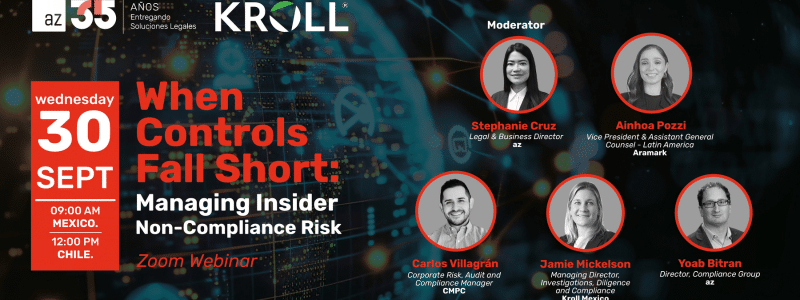
We invite you to watch the recording of the webinar “When Controls Fall Short: Managing Insider Non-Compliance Risk,” which we hosted in partnership with Kroll.
On Wednesday, September 30, we hosted the webinar “When Controls Fall Short: Managing Insider Non-Compliance Risk” in partnership with Kroll. The session was moderated by our Director of Legal & Business, Stephanie Cruz, and featured our Director of the Compliance Group, Yoab Bitran.
During the session, we addressed the main challenges associated with managing insider non-compliance risks, analyzing how organizations can strengthen their compliance management frameworks and address situations where existing controls prove insufficient.
The panel also included Ainhoa Pozzi, Vice President & Assistant General Counsel – Latin America at Aramark; Carlos F. Villagrán, Corporate Risk, Audit, and Compliance Manager at CMPC; and Jamie Mickelson, Managing Director, Investigations, Diligence, and Compliance at Kroll Mexico.
Here are five key takeaways from the session:
Recognizing warning signs | Misconduct does not always begin with an obvious violation. Identifying warning signs early and paying attention to potential compliance breaches makes it possible to assess risks before the issue escalates.
Taking action from the outset | The first 24 to 48 hours are critical in determining how to respond. Key priorities include securing available evidence, containing risks, and establishing the initial scope of the investigation.
Understanding what went wrong | Not all issues have the same root cause. It is important to determine whether a control was poorly designed or deliberately circumvented. Distinguishing between these scenarios helps clarify what happened and define an appropriate response.
Conducting an objective investigation | An internal investigation requires a rigorous review of the facts, maintaining confidentiality, and properly coordinating actions and communications. It must also comply with applicable procedures and protect individuals who report potential misconduct from retaliation.
Addressing gaps to prevent recurrence | The response does not end when the investigation is concluded. The findings should be used to review existing controls, address weaknesses, and strengthen the organization’s preventive measures.