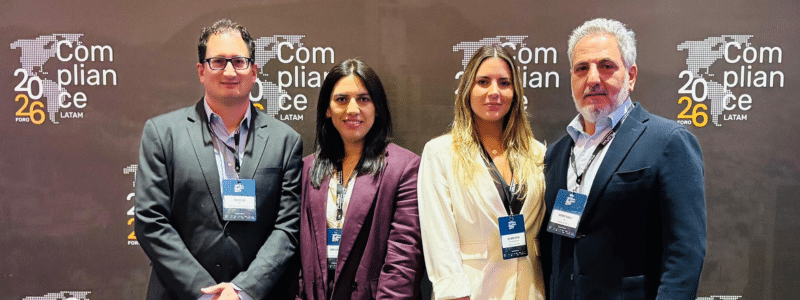
We invite you to read the opinion piece by our directors Yoab Bitran (Compliance Group) and Juan Pablo González (New Technologies and AI) on the challenge of integrating data protection into organizational culture.
The implementation of new requirements regarding personal data protection is leading many organizations to review their contracts, policies, procedures, and internal governance structures—including creating new roles within existing departments or evaluating the creation of new ones. All of this is necessary, but there is one aspect that may ultimately prove more decisive: how the way people work actually changes when the rules change.
Organizations develop habits and ways of solving problems that become normalized over time. Many of these practices work well within the context in which they arose and may even have been valued because they allow for better customer service, faster responses, or easier coordination. The problem arises when regulations change and some of those same behaviors begin to create risks that did not exist before or were much less significant. With the imminent—or perhaps slightly delayed—entry into force of the reform to personal data regulations, this phenomenon is becoming apparent.
A clinical team that shares patient information via private email or other means to quickly resolve a query, including at the patient’s own request; a sales team that has built its own contact database over the years, or employees who use personal data to facilitate patient care, may be acting out of a perfectly understandable desire to streamline their work; however, they may expose us to the risk of fines as well as reputational damage, which becomes particularly relevant in light of new regulatory requirements.
This is where one of the main challenges of implementation lies, particularly with regard to this regulation. A policy can be drafted in a few weeks, a clause can be amended, and training can be conducted for the entire organization—but that does not mean that day-to-day practices will change at the same pace. People continue to operate based on what they know, the incentives they have, and the ways they have learned to do their jobs.
That is why it is important to incorporate the human and organizational dimensions into compliance processes early on. In addition to reviewing whether appropriate policies, procedures, and controls are in place, it is necessary to examine which current practices may be out of alignment with the new regulations, where the main risks are concentrated, which teams will need to change deeply ingrained behaviors, and what capabilities they need to develop to do so. This goes beyond simply creating a training course on the main aspects of the regulations; it involves understanding the behaviors that need to be changed and, starting at the C-level, developing strategies that are supported by the Board of Directors and communicated down to every member of the organization.
In many cases, the best approach is to start with specific areas where regulations, processes, and behavior intersect. These might include the sales force, a medical team, customer service, marketing, or human resources. Working on these areas helps bring to light behaviors that have become invisible precisely because they have been in place for years, and allows for the design of responses that manage risk without losing sight of operations.
The Personal Data Protection Act brings this challenge into sharp focus, but we will likely see something similar with artificial intelligence and other new regulations. Every regulatory change alters the conditions under which organizations operate and demands new capabilities, new decisions, and, in many cases, new ways of working.
Preparing effectively means understanding that regulations ultimately always translate into specific behaviors. It is there—in the way people make decisions, exchange information, coordinate with one another, and solve problems every day—where a significant part of compliance effectiveness ultimately comes into play.
Column written by:
Yoab Bitran | Compliance Group Director | ybitran@az.cl
Juan Pablo González | New Technologies and AI Director | jgonzalez@az.cl