Macarena Waidele, a senior associate in the Corporate and Business Group, and Claudia Delgado, an associate in the Public Law and Regulated Markets Group, spoke exclusively with LexLatin to discuss the impact of the Framework Law on Sectoral Authorizations and the National Reconstruction Plan on investing in Chile.
Chile is changing the rules governing the approval and implementation of major investment projects. One of the reforms, the Framework Law on Sectoral Authorizations, was passed during the administration of Gabriel Boric and aims to reduce processing times and simplify the permitting process. The other is the National Reconstruction Plan, promoted by current President José Antonio Kast, which proposes new rules to provide greater stability for projects that have already received authorizations.
These are distinct initiatives that emerged under different administrations, but both seek to address a problem that has gained prominence in recent years: how much time and certainty an investment needs to move from the drawing board to the construction site—from the first permit to the last, and from administrative approval to the start of construction.
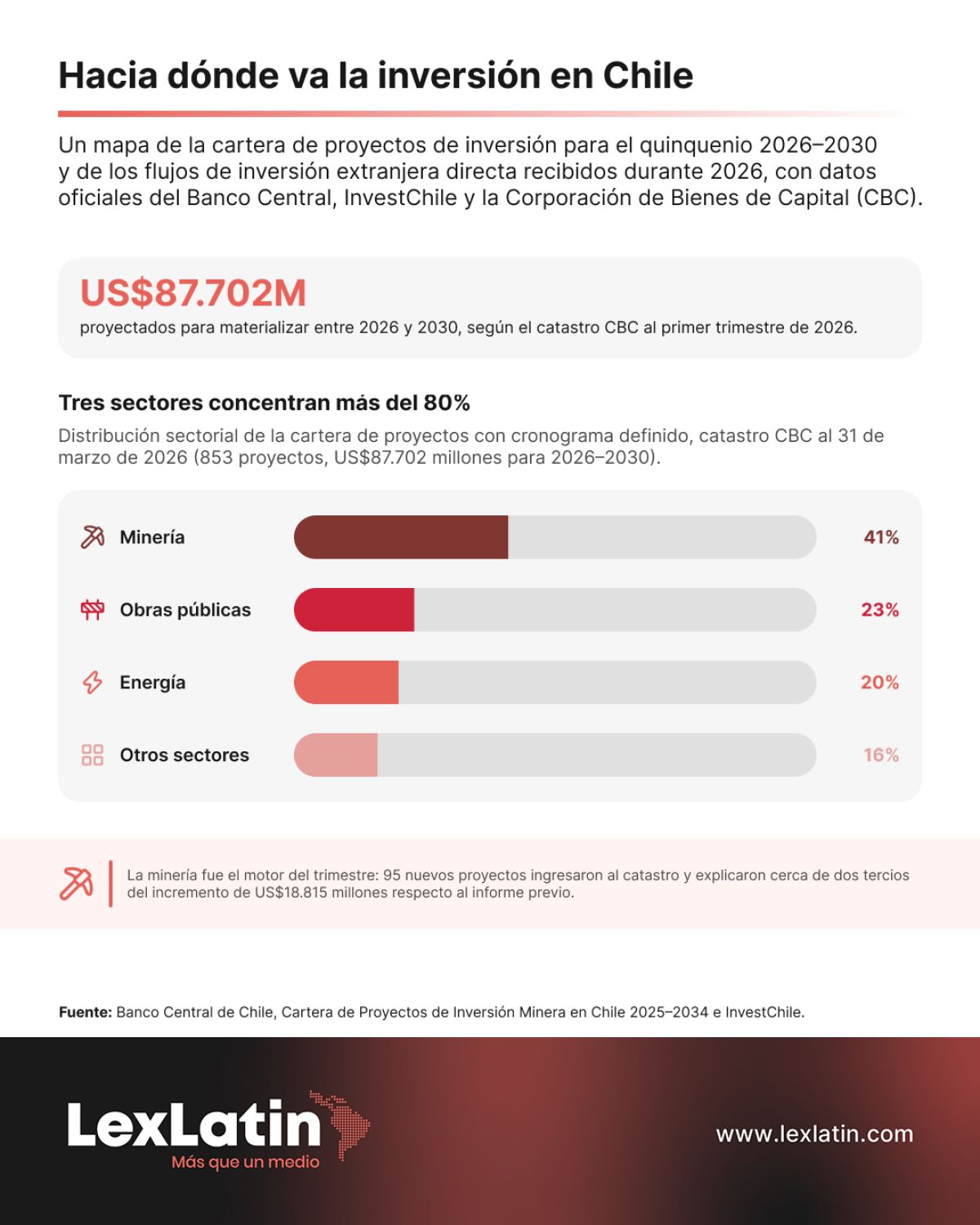
More than half of Chile’s projected investment portfolio for the next five years remains unimplemented. Of the US$87,702 million that the Capital Assets Corporation (CBC) Land Registry projects will be implemented between 2026 and 2030, based on information as of March 31, 2026, 43% corresponds to projects under construction, while the remaining 57% remains in stages prior to the start of construction. The portfolio comprises 853 projects with defined timelines, although a significant portion is still awaiting permits and authorizations to move forward.
In this regard, three industries account for nearly 84% of that total: mining (41%), public works (23%), and energy (20%)—the very sectors where the permitting process is currently the most critical factor affecting project timelines.
The scope of these changes and their implications for Chilean companies are analyzed by Macarena Waidele, a senior associate in the Corporate and Business Group, and Claudia Delgado, an associate in the Public Law and Regulated Markets Group at the law firm az, who discuss the current status of both initiatives and the risks that regulatory and environmental departments should anticipate for their pending projects.
One-Stop Shop, Gradual Implementation
The first of the two reforms that have shaped the process of modernizing Chile’s permitting system is Law No. 21,770, the Framework for Sectoral Authorizations, which was introduced during the administration of Gabriel Boric and published on September 29, 2025. The law aims to organize, standardize, and simplify the processing of authorizations granted by the government for regulated projects and activities, incorporating mechanisms for digitization and parallel processing of permits. However, it does not apply to authorizations processed entirely within the Environmental Impact Assessment System (SEIA); rather, it establishes a framework for sectoral authorizations and does not replace the procedures under the SEIA.
Projects requiring multiple sectoral permits—as is commonly the case in mining, energy, and infrastructure—are the primary beneficiaries of the parallel processing and digitization introduced by the Unified Sectoral Permits Information System (SUPER).
The platform, available at super.gob.cl, functions as a digital one-stop shop for submitting, processing, and tracking applications with various public agencies. By the end of 2025, it already encompassed more than 250 procedures, and since then, it has continued to incorporate new institutions, including the Agricultural and Livestock Service, the National Monuments Council, and the Ministry of Housing and Urban Development.
“This transition, however, is still gradual, as the recently established timeline does not require full operational capacity until late 2026 and 2027, depending on the specific group of organs in question; therefore, the experience varies significantly from one service to another. An example of this is the regulation governing access to, use of, and operation of SUPER, as required by Article 57 of Law No. 21,770, which was not signed until June 25, 2026—at the very end of the nine-month legal deadline following the law’s publication—and is currently still pending acknowledgment by the Comptroller General of the Republic, and therefore its full entry into force remains pending. Thus, in practice, this means that companies are seeing regulatory changes that are already in effect on paper, but with uneven adoption across services,” explains the associate from az’s Public Law and Regulated Markets Group.
Three Implementation Speeds
Regarding the impact these changes may have on timelines, attorney Delgado identifies three scenarios:
- Low-risk, high-volume permits: The effect may be more immediate for standardizable authorizations that can be processed through a notice or an affidavit, with subsequent verification of compliance.
- Projects requiring multiple sector-specific permits: Mining, energy, and infrastructure projects could see shorter timelines thanks to parallel processing and the interoperability of files through SUPER, although this will depend on the level of digital implementation among the agencies involved.
- Strategic investments: These projects could see a reduction of up to 50% in maximum processing times. Its impact, however, has yet to be proven in practice, as the mechanism is currently being implemented.
The main limitation, for now, is that not all agencies operate under the same digital standard. More than 30 agencies must adapt their procedures to the new system, and their integration will take place gradually, with a deadline of December 2027.
Strategic Investment: Who Decides
In addition to this mechanism, certain low-risk authorizations may be granted through a notice or an affidavit rather than a prior resolution, reducing the process to a subsequent verification of compliance.
Along these lines, in early August, the Kast administration submitted to the Comptroller General’s Office an amendment to the Mining Safety Regulations that streamlines 55 sector-specific authorizations into 13 permits and 18 alternative technical approvals. This adjustment proceeds in parallel with the modernization of the Environmental Impact Assessment System (SEIA), for which the public comment period closed on September 11.
There is one category with an even greater reduction in processing times: initiatives classified as strategic investments, which are eligible for a 50 percent reduction in maximum processing times.
“In these cases, the designation is neither automatic nor left to the discretion of the applicant, as it is the responsibility of the ministers of the Interior, Finance, Economy, Public Works and Tourism, Social Development and Family, and the Environment to make the determination based on a list prepared annually by the Office of Sectoral Authorizations and Investment following a technical evaluation,” the document specifies.
The selected initiatives are added to a registry maintained by the Office of Sectoral Authorizations and Investment for ongoing monitoring. The regulations establishing the objective criteria and the application procedure for this category were subject to public consultation in February 2026 and, to date, have not been published.
The Challenges of the Transition
Nearly a year after the enactment of Law 21,770, companies are facing a transition that is proceeding gradually and unevenly across different public utilities. At least four challenges remain:
- regulatory dependence: since this is a “framework” law, its implementation requires regulations and guidelines that are still under development, including standard forms, criteria for strategic initiatives, and SUPER specifications;
- coordination among more than 30 agencies, each with its own systems and procedures—compounded by SUPER’s regulations, a central component of the digitization process;
- “positive administrative silence,” which aims to prevent the government’s inaction from halting projects but may result in authorizations that are more vulnerable to challenges seeking their annulment and, consequently, a new source of uncertainty;
- the transitional regime, which stipulates that procedures initiated before September 29, 2025, will, in principle, continue under the previous rules.
Given this scenario, Delgado offers four recommendations to companies with projects in the pipeline:
- Identify, permit by permit, whether the procedure was initiated before or after the effective date and under which regulatory framework it is being processed.
- Do not assume that the maximum deadlines or parallel processing automatically apply to all your permits; verify which phase of the phased implementation each competent authority is in.
- Document regulatory compliance in procedures that may be resolved by implied approval, given the risk of subsequent challenges.
- Maintain buffer periods in your timeline despite the announced goals for reducing processing times (between 30% and 70%), as these are aggregate system objectives and not guarantees for individual proceedings.
Second Reform: Protecting What Has Already Been Approved
While the first reform aims to speed up the path to obtaining a permit, the second focuses on what happens after it is granted. This second front is addressed by the National Reconstruction and Economic and Social Development Plan—also known as the Miscellaneous Act—which President Kast signed on April 22, 2026, and sent to Congress with the highest legislative priority.
The initiative addresses five key areas: taxation, formal employment, regulatory streamlining, legal certainty, and containment of public spending. Among its measures, the bill proposed reducing the deadline for invalidating certain administrative acts from two years to six months. During the legislative process, this deadline was amended to one year.
“Reducing the timeframe for invalidating certain sector-specific permits from two years to six months would be positive, as it would limit the period during which a sector-specific authorization may be subject to ex officio review. This directly facilitates investment decision-making, the closing of financing deals, and the achievement of construction or operational milestones. For a company that owns a project, this improves financing conditions and reduces contingencies in due diligence processes and investment agreements. However, the benefit must be analyzed on a permit-by-permit basis,” notes the senior associate of az’s Corporate and Business Group.
The bill also limits the duration of precautionary measures that could halt already-approved projects to six months and grants the Environmental Assessment Service greater authority to screen the comments submitted by sectoral agencies during the environmental assessment.
“It is important that companies not assume that an authorization is final simply because six months have passed. When reviewing a project’s status, they must continue to consider the processing of its RCA, if applicable, oversight powers, and the latent risks of legal challenges,” the attorney warns.
The Environmental Bottleneck
Despite progress in processing sector-specific permits, the specialist states that environmental assessment remains the most significant bottleneck for mining, energy, and infrastructure projects.
“This law does not apply to authorizations processed entirely within the SEIA, but it does apply to sector-specific permits associated with projects under the RCA, which must be resolved outside the system. The major operational advantage is that sectoral agencies will no longer be able to demand new environmental data that has already been evaluated, nor impose conditions beyond those established in the RCA,” she emphasizes.
The az spokesperson notes that a project’s financial closing and construction timeline will continue to be subject to the duration of the SEIA process, to permits that depend on other prior authorizations, to binding reports, to third-party participation, and to any administrative or judicial appeals that may arise along the way. Furthermore, the law itself provides for grounds that suspend the calculation of processing deadlines, including requests for additional documentation, intervention by the Comptroller General of the Republic, and dependence on another prior authorization.
For this reason, the attorney suggests that the financial model for mining, energy, or infrastructure projects distinguish between milestones and permits:
- environmental approval;
- permits required to begin construction;
- permits required to begin operations;
- those subject to administrative silence;
- those that depend on the prior issuance of another authorization.
Risks and Controls to Strengthen
Tacit administrative approval addresses the administration’s inaction but results in authorizations that may be considered less robust and more vulnerable to challenges seeking their annulment. Added to this is the transitional regime, as proceedings initiated before September 29, 2025, continue, in principle, to be governed by the rules in effect prior to the reform.
“A favorable RCA does not necessarily eliminate the need for subsequent sector-specific permits or exposure to environmental claims. The National Reconstruction bill proposes limiting administrative reviews of favorable RCAs, but it maintains the right to file claims before the Environmental Courts,” notes Waidele.
In light of these risks, the associate proposes a set of controls for companies with ongoing or planned projects:
- Develop a permitting matrix linked to the project’s timeline and financial model.
- Define a clear contractual allocation of regulatory risk among the parties involved.
- Conduct specific due diligence on the start date of each sector-specific procedure.
- Submit affidavits and supporting documentation filed with the authority to independent technical and legal review.
- Set aside a contingency fund for potential delays, litigation, or regulatory changes.
Chile’s Regional Advantage
Chile is currently competing with other Latin American markets to attract investment in mining, energy, and infrastructure. Law 21,770 already provides features that other countries in the region do not offer in an integrated manner, such as the interoperability of data and electronic files among sectoral agencies through SUPER, the traceability of each application, and regulatory stability for up to eight years for certain sectoral authorizations linked to investment projects that have received a favorable RCA.
If we consider the National Reconstruction Bill, once enacted, it would add to this package a shorter period during which a permit is open to challenge before it becomes invalid, as well as a restriction on the administrative review of favorable environmental resolutions.
“The advantage will not simply lie in processing fewer permits or doing so more quickly, but in being able to assess risks related to timing and validity with greater precision, commit capital in stages, and secure financing with less regulatory uncertainty,” concludes the specialist from az’s Public Law and Regulated Markets Group.
With the SUPER platform expanding month by month and a second reform on the verge of publication, Chile is playing a decisive card in the second half of 2026 to establish itself as a more predictable destination.