
Our partners Rodrigo Albagli and Álvaro Rosenblut spoke exclusively with LexLatin, where they addressed the key aspects of the Mega Tax Reform that companies and individuals should consider.
In Chile, the so-called mega tax reform of the José Antonio Kast administration—also known as the National Reconstruction Act—was passed by Congress on August 4 and is now in the final stages of the legislative process. The initiative, formally titled the Bill for National Reconstruction and Economic and Social Development, introduces changes across various areas of the tax system. For individuals and families with assets in the country or investments outside Chile, the focus is on how these rules may affect the organization and transfer of their assets.
The reform includes changes that affect various areas of estate planning, ranging from gifts and inheritances to corporate structures and assets held abroad. Some measures are permanent, while others are subject to specific time frames, making it important to distinguish what the bill entails and when its provisions might take effect.
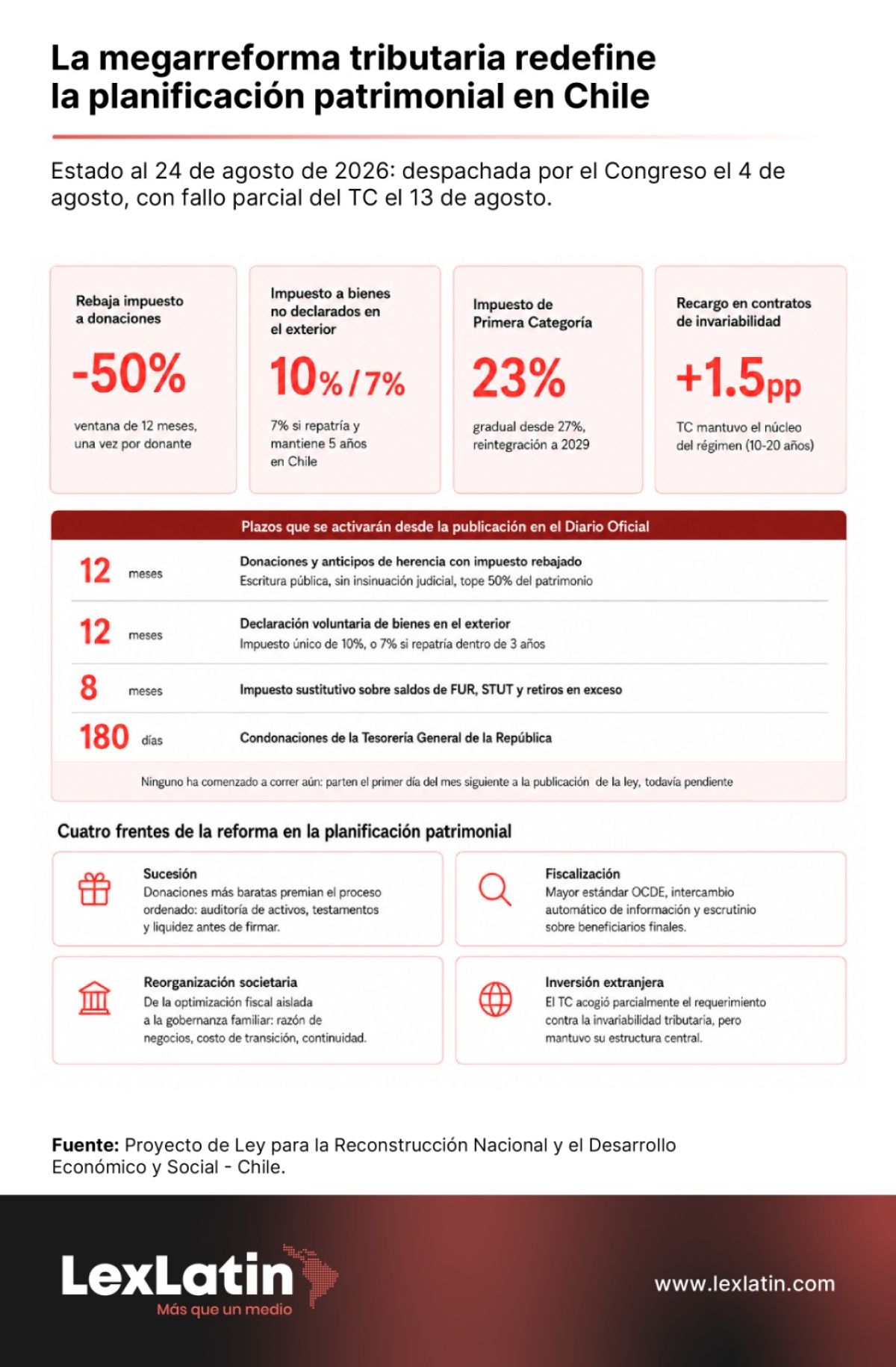
When it comes to long-term investments, the bill that passed Congress is no longer the same as the one originally debated. On August 13, the Constitutional Court ruled that, among other provisions, the tax stability provision included in the bill was unconstitutional. The measure was intended to provide stability for certain large-scale investments, and its removal altered one of the elements designed to attract capital.
The result is a scenario that combines changes in family wealth planning, new reporting requirements, and modifications to the conditions considered for certain investments.
Legal Certainty Under Review
One of the changes of greatest interest to those evaluating long-term investments in Chile concerns the tax certainty provision set forth in Article 29 of the bill.
Álvaro Rosenblut, a partner in charge of the corporate practice at az and a specialist in mergers, acquisitions, and regulated markets, notes that the objective was to provide stability for large-scale investments, where capital recovery can span decades.
The mechanism was designed for projects of at least US$50 million in capital-intensive sectors, including mining, manufacturing, forestry, energy, infrastructure, telecommunications, research and development, and the medical and scientific fields. Contracts with the government provided for different periods of tax stability depending on the investment amount:
· 10 years for investments between US$50 million and less than US$100 million.
· 15 years for investments between US$100 million and less than US$350 million.
· 20 years for investments of US$350 million or more, counted from the project’s start-up.
The spokesperson notes that the stability provided was not limited to corporate income tax:
- It froze the total effective income tax burden, including the tax rate, the tax base, and other tax elements in effect at the time the contract was signed.
- It encompassed the VAT regime and import tariffs on capital goods during the project’s execution, as well as the Internal Revenue Service’s rules and interpretations regarding depreciation, loss carryforwards, and organization and start-up expenses.
- In the mining sector, it also provided for the setting of the royalty rate and the exclusion of new sector-specific taxes and more onerous amendments to mining concessions.
This benefit came at a cost to the investor. The First Category Income Tax rate applicable to the contract increased by 1.5 percentage points. As Rosenblut notes, the rationale was that the company would pay to obtain tax stability during the agreed-upon period.
“Limiting its application has concrete consequences. First, it increases the cost of capital: as certainty disappears, regulatory risk is factored into the discount rate, and projects that were viable cease to be so. Second, it particularly affects long-term, less mobile projects—such as mining, energy, and infrastructure—which are precisely the ones the bill sought to attract. Third, it reduces competitiveness compared to jurisdictions in the region that do offer contractual stability, in a context where capital competes for investment destinations. Fourth, it shifts the discussion toward less efficient mechanisms: contractual compensation clauses, structuring through investment treaties, and increased litigation. And fifth, it puts local investors at a disadvantage, as they were originally granted the same rights and terms under the original design,” explains the attorney.
For Rosenblut, the ultimate impact of the Constitutional Court’s decision will depend on the text that emerges from the legislative process and the conditions ultimately established for long-term investments. Chile, he argues, retains key attributes for international capital, including institutional strength, respect for property rights, and a broad network of treaties to avoid double taxation. The ability to continue competing for investment will also depend on whether the new rules can be applied in a predictable and technically sound manner.
A 12-Month Window for Transferring Assets
Rodrigo Albagli, founder of az and the firm’s chief strategist for more than three decades, highlights one of the measures that could have the greatest impact on estate planning: the 50% reduction in the tax on gifts and advance inheritances.
“It may be used only once per donor, through a notarized deed executed within one year from the first day of the month following the law’s publication, and without the judicial filing currently required by regulation,” he explains.
The reduction applies to gifts made to statutory heirs—including children, ascendants, a surviving spouse, or surviving civil partner—and to beneficiaries of the “cuarta de mejoras” (a specific share of the estate), in whatever proportion the donor freely determines. The amount transferred may not exceed 50% of the donor’s estate, and the donor must prove that they retain assets worth at least twice the amount transferred. Furthermore, the notary may not authorize the deed without prior payment of the tax, as certified by the Internal Revenue Service.
“When these requirements are read together, it becomes clear that the measure rewards an orderly process and penalizes improvisation. A last-minute decision to make a donation—without having defined which assets are being transferred, to whom, and under what governance structure—may result in tax savings but could create a much more costly estate and family problem: fragmentation of ownership, loss of control over the operating company, illiquid assets in the hands of those unable to manage them, or conflicts between family branches with no mechanism for resolution,” says Albagli.
To avoid this scenario, the founder of az recommends reviewing three aspects before formalizing any deed of donation.
- An audit of assets and valuations to identify any latent tax contingencies within the family’s estate.
- A review of wills and shareholder agreements to ensure that these instruments reflect the founder’s current wishes and do not block decisions following the generational transfer.
- A liquidity assessment that allows the family to meet the tax obligations of the transition without being forced to liquidate strategic assets or sell under time pressure.
Regarding the financing of this last point, Albagli clarifies that the bill permits loans or promissory notes issued by the donated companies or their affiliates—without triggering Article 21 of the Income Tax Law—denominated in units of fomento and with a maximum term of ten years.
He adds that the transfer alone does not replace family protocols or shareholder agreements.
“Without those corporate governance rules—which define management, dividend policy, and valuation and exit mechanisms—the transfer may distribute ownership without establishing how decisions will be made among the heirs,” he explains.
There is also a consideration for those who receive the assets and plan to sell them later. If the donee disposes of the asset within three years of receiving it, the applicable tax basis will be the lower of the basis that would have applied to the donor or the basis established by general rules. This requires considering the holding period as well, not just the time of the transfer. Gifts between spouses, he added, are taxed as irrevocable and are also eligible for the 50% reduction. Furthermore, prior gifts made by the same donor are not taken into account when calculating the tax.
“The 12-month window is a good catalyst for implementing planning that many families already had pending, but the variable isn’t just tax-related. The decision must take into account the family’s asset protection, the continuity of the business, governance, and equity among heirs. Tax savings are the result of a well-executed process, not the sole objective,” he emphasizes.
Tax Audits and Asset Transparency
Rosenblut emphasizes Chile’s progress toward a wealth oversight standard more closely aligned with the requirements of the Organization for Economic Cooperation and Development (OECD) and with the automatic exchange of information among tax authorities. The new landscape expands scrutiny of the origin of funds, transactions between related companies, and the identification of the ultimate beneficiaries behind each structure.
“This will compel individuals to professionalize the management of their family offices and maintain impeccable tax records, recognizing that the current audit standard requires demonstrating the actual economic basis behind every financial transaction,” the partner notes.
When asked about the balance between this greater transparency and the right to privacy, Rosenblut comments that transparency is legitimate and necessary to combat tax evasion, but it should not result in the undue disclosure of personal information to third parties unrelated to the audit. The middle ground, he argues, requires that the data provided to the tax authority be subject to strict confidentiality obligations, effective cybersecurity safeguards, and the government’s responsibility for its safekeeping.
In fact, this change is already evident among its clients: families that until now have managed their wealth informally are beginning to formalize their structures, while the scope for opaque arrangements—which for years served to defer tax payments without significant oversight by the tax authorities—is shrinking.
From Tax Savings to Family Governance
Albagli argues that the reform changes the criteria families must use to evaluate their wealth structures. Tax savings are no longer the sole focus, and family governance and regulatory compliance are gaining importance. For years, many family and corporate structures in Chile were designed to pursue isolated tax optimizations, without necessarily having a business purpose behind them.
“Historically, many family and corporate structures in Chile were designed to achieve specific tax optimizations. With new traceability requirements, anti-avoidance rules, and changes in capital and estate taxation, asset protection no longer depends on the sophistication of the tax vehicle, but rather on the strength of family governance, the legitimacy of the structures, and the proper alignment between business strategy and tax compliance,” states the spokesperson for az.
In the firm’s day-to-day work, Rosenblut observes a simplification of corporate structures. Families and business owners are dismantling complex structures that lack a legitimate business purpose, because today they generate more compliance costs than benefits and leave them more exposed to potential audits. At the same time, he observes a deliberate effort to separate operating assets—those that concentrate business risk—from income-generating or equity assets, such as real estate or financial assets, protecting the latter under more robust governance structures.
Before undertaking any restructuring, the partner suggests weighing four factors:
- A legitimate business rationale, based on a specific economic or family logic and not solely on tax savings.
- The transition cost, assessing which taxes the reorganization itself may trigger and the criteria used to value the contributed assets.
- Corporate governance, defining who manages the business, what rights family members have outside of management, and how conflicts are resolved.
- Business continuity, ensuring that the reorganization does not affect commercial operations or relationships with suppliers, customers, or the financial system
Exemption for Those Age 65 and Older
The 100% property tax exemption for people aged 65 and older is one of the most attractive benefits for families who own real estate. However, its conditions limit its use as a tool for estate planning. The measure is permanent and takes effect on January 1 of the year following the law’s publication.
The benefit applies to only one residence per taxpayer nationwide, which must be their primary residence, and includes parking spaces and storage units at the same address. It requires an annual affidavit filed with the SII, being current on the payment of the previous year’s property tax and sanitation fees, and excludes properties acquired from related parties within the three years prior to the filing, unless a reason other than a purely tax-related one is demonstrated. Misuse is punishable by a fine of 300% of the evaded tax and a ten-year ban on reapplying for the benefit.
“This measure is unlikely to create many opportunities for estate reorganization. The exemption requires that the property be registered in the name of a taxpayer who is an individual aged 65 or older and that it be their primary residence: it does not apply to properties held by investment companies, undissolved inheritance communities, trusts, or indirect ownership structures—which is precisely where many families hold their real estate assets,” warns Rosenblut.
According to the attorney, transferring properties into the senior’s name to qualify for the exemption offers very limited scope, since the rule excludes properties acquired from related parties during the preceding three years and provides for penalties in the event of misuse of the benefit.
In this scenario, the focus is more on putting the existing situation in order than on modifying the estate structure. Tasks include verifying that the senior’s primary residence is indeed registered in their name, regularizing any pending actual possessions that keep the property in a hereditary community, bringing property taxes and sanitation fees up to date, and filing the annual affidavit within the corresponding deadline.
The decisions with the greatest impact, however, are found in two other provisions of the real estate package:
- The first measure pertains to the new DFL-2 regime, which establishes a flat 5% tax on rents for affordable housing units of up to 90 m², starting with the third property.
- The second measure provides for a temporary VAT exemption for the first sale of housing units that have received final occupancy approval.
Deadlines that have already begun to run
Albagli emphasizes that several of the transitional measures have short deadlines. The reduction in the gift tax is in effect for one year; the voluntary declaration of assets held abroad, for twelve months; the substitute tax on FUR and STUT balances and excess withdrawals, for eight months; and the debt forgiveness granted by the General Treasury of the Republic, for 180 days. All deadlines begin to run from the date the law is published.
The declaration of assets held abroad provides for a one-time 10% tax on undeclared assets. The rate drops to 7% if the taxpayer repatriates the funds within the first three years following the law’s publication and keeps them invested in Chile for at least five years. The investment may be made in real estate, securities, or other instruments backed by local assets. If the taxpayer does not meet the minimum holding period, they must repay the tax difference, along with interest and adjustments.
Rosenblut recommends getting a head start on gathering information about family assets: taking inventory of family assets, reviewing historical balances in FUR and STUT accounts, identifying assets held abroad, and verifying the ownership structure. With this information, families can evaluate each option before the respective deadlines expire.
The permanent regulations also affect family businesses: the reduction of the First Category Tax to 23%, the gradual reintegration of the tax system, and the phased elimination of the 35% refund gradually lower the effective cost of withdrawing profits. The timing of withdrawals and distributions thus becomes a key consideration for each partner.
Both partners at az emphasize that the reform may still undergo adjustments before its official publication. Its implementation is also subject to the regulations and instructions issued by the Internal Revenue Service. For now, decisions must take into account the deadlines established in the draft and any changes that may be incorporated into the final text.